|
| Rice steamed in bamboo husks, traditional to the indigenous tribe that lives in the area |
 |
| Eggs hardboiled in the hot springs |

|
| Rice steamed in bamboo husks, traditional to the indigenous tribe that lives in the area |
|
| Eggs hardboiled in the hot springs |
 |
This is the last week of my monthlong winter break, which in Asia centers around the Lunar New Year instead of Christmas. It was exciting to be here for the single most important holiday of the Asian world. The world’s largest annual human migration occurs as city-dwellers go home to visit their families, sometimes for the only time that year. This is why domestic travel bans have such a big impact on migrant workers in China, who often have no other opportunity to see their children and parents in their smaller hometowns.
While the anticipatory air leading up to the new year was special, it was also nerve-racking knowing that most businesses would be shutting down for a full week, and Taipei was about to become a dead city with few places to find food.
 |
| Fun fact: if you go to MacDonald’s on the 31st, they will give you a red envelope |

1/30: Considered the last day of this lunar year. Everyone cleans their house to prepare for 除夕 New Year’s Eve. I swept my dorm in comradeship with the other 2 billion people doing it that day to welcome in a new year. Then, I went with friends to the traditional new year’s market on the historical 地話 Dihua Street.
 |
| People often gift oranges in the New Year season |
 |
| The historic LNY market was full of Taiwanese treats and nuts |
1/31: 除夕 New Year’s Eve Everyone has a 團圓飯 or a big reunion meal with their whole family, then they 守歲 or stay up all night to see out the old year and ring in the new. I went on a run through the neighborhoods this morning and saw so many people burning joss paper in tiny portable fire pits on the street in front of their apartments. Joss paper is sheets of gold and red set aflame to honor those who've died.
2/1: 大年初一 First Day of the New Year This is the day when younger people will 拜年 or pay their respects to elders. In practice, children will spend time with their grandparents, and their grandparents will give them 紅包, red envelopes filled with money. Red envelopes are very symbolic of the holiday; bosses will use them to give bonuses to their employees, and friends will exchange them with cards inside.
2/2: 大年初二 Second Day of the New Year Traffic is especially busy on this day, because traditionally women will 回娘家, or go back to their families, while they were with the man’s family earlier in the week.
2/3: 大年初三 Third Day of the New Year Children have been running around wild with their cousins for the past week, so parents tell them today is 老鼠娶親, when the rats are getting married, so everyone needs to be quiet and go to bed early.
2/4: 大年初四 Fourth Day of the New Year
2/5: 大年初五 Fifth Day of the New Year A few businesses will start to 開市, reopen, on this day, so everyone is celebrating prosperity in the new year and setting off even more firecrackers. There were firecrackers every day for a week straight; I have never seen so many in my life.
 |
| To use a Chinese karaoke book: first you find your language, then the number of characters in the name of the song, then the number of strokes in the first character |
 |
| One Steamed Bun for 25 The phrase tells you how to pose for each photo |

I attended a lunar new year party at my high school Chinese teacher’s sister’s house. Her friends all brought home-cooked dishes and traditional sweets. For the second time this holiday, I found myself at a Chinese karaoke party. I sang 月亮代表我的心,which I keep on standby because all the Taiwanese aunties love it. We played Rummikub, which is similar to mahjong. Everyone took photos holding red envelopes and other decorations, and we took endless group photos. They all told me about their single sons who were close, or not, to my age. The atmosphere was so festive; it made me realize this is what I was missing during the Christmas season.


Over winter break, I took an intensive course called Cultural Competence in Global Health, where we traveled to Hualien to visit indigenous communities, discuss readings, and participate in conversations about culture and health.


About 2% of Taiwan is indigenous--descended from the Austronesian language family speaking peoples who walked across the Taiwan Strait back when it was grassy plains about 4000 years ago. Back then Taiwan was the mountainous southeastern coast of continent, whereas now the island is separated from mainland China by the Taiwan Strait. Many distinct cultures and languages exists, but only about one tenth of indigenous Taiwanese can speak their ancestral language.
 |
| 貓公 Fakong tribal community |
 |
| Elders of the community preparing betel nut, a chewable plant that's carcinogenic but important culturally |
 |
| A traditional gathering place for the Amis community |
 |
| Visiting the Wild Vegetable School, where indigenous foraging is taught to youth |

 |
| My friends and I posing with our snacks |
 |
| Post by a Taiwanese friend on the trip |
 |
| Lunch break between classes |
 |
| The American Global Health Program students on the trip |
 Fulbright friend, I visited Alishan National Park for the first time. The fog-outlined alpine trees outside our lodge kept reminding me of ski trips, as did being sweaty underneath and slightly damp above multiple layers. With the altitude, the temperature dropped to the 40s at night, the coldest weather I’ve encountered in Taiwan yet. I loved the most immersive forest feel of Alishan, complete with fresh mountain air, that other hikes right around Taipei seemed to lack. We hiked every single trail in the park, including the peak famous for the sunrises above the sea of clouds. We decided we could hike the whole trail before sunrise, unlike most of the Taiwanese people who smartly take the shuttle...we ended up racing up the trail in order to arrive actually by sunrise. Unfortunately, it was too cloudy to see anything anyways except white clouds getting brighter white. Afterwards, we had breakfast and local tea at a teahouse by the summit. We did two other big summits that day including one in which we found ourselves once again racing up because we were in a time crunch. We were literally running down the mountain to catch the last bus to Sun Moon Lake.

 |
| Sunrise summit |

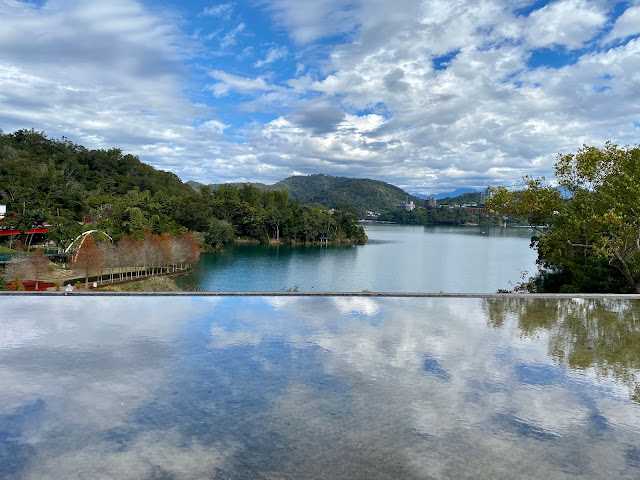
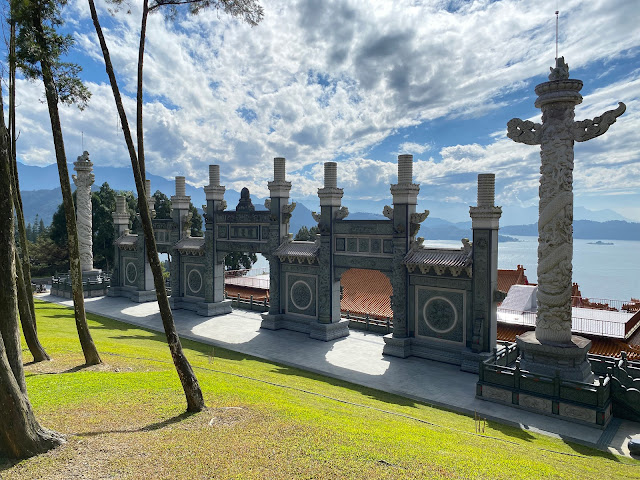
With very sore legs, we woke up for sunrise over Sun Moon Lake prior to a bike ride around it. The 環潭 around-the-lake cycle has been named one of the top five greatest routes in the world. It truly was so spectacular, it could make you crash your bike. There were a couple steep climbs but each rewarded with mountain-top temples. The rest of the route was right along the lakeside, often on a special cycling path built up right above the water. When renting the bikes, we first turned down an offer to rent electric bikes to which the man replied that foreigners always want to peddle themselves.